1. Autopsy results show alveolar-capillary micro-thromboses are nine times as prevalent in the patients who died from COVID-19 compare to deaths from H1N1. 2. Thrombosis is a prevelant feature in multiorgan injuries. It is prominent in the pulmonary micro-vasculatures, alveolar capilaries approaching 90% of the times.
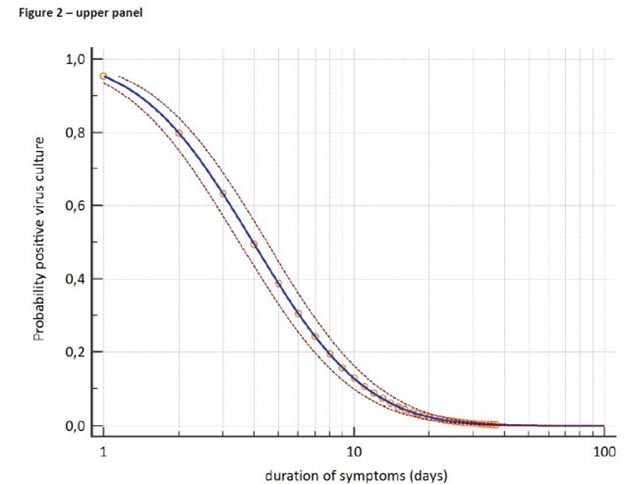
3. Thrombosis likely plays a role very early in the disease process. These thromboses are platelet-rich. 4. Multiple inflammatory markers provide evidence and allow tracking of systemic inflammation. The cytokine storm seems to peak in the pulmonary phase of the illness around day seven (D#7) after symptom onset. 5. The likelihood of recovering replication competent virus progressively declines after symptom onset. In mild to moderate COVID-19, recovering a replication competent virus is less likely after D#10. In severe cases and those with immunocompromised states, 88-95 % of the specimens are unlikely to yield replication competent virus beyond D#15 of symptoms. 6. Injuries triggered by COVID-19 are steroid-responsive. 7. Anticoagulants have been shown to impact mortality. 8. Vitamin D diminishes disease progression and, likely, severity.
Timelines of recovering replicable SARS COV -2 from the upper respiratory tract. (Graph derived from published numerical data provided by CDC)
Discussion:
While inflammatory dysregulations and microvascular thrombosis may account for mortality risks, the micro-vascular thrombosis could be contributing to both mortality and long term morbidity. These primary pathophysiologies are progressive on a daily basis. Most patients developing dyspnea by D#7 while entering severe to critical phase at D#10.
From what we know thus far, we can divide COVID-19 into two phases:
Viral Phase until D#7 of symptoms
Inflammatory and Thrombotic Phase, beyond D#7.
This framework give us a model for a targeted therapeutic approach:
INPATIENT PROTOCOL (LOVEDEX+) Acute care medicine has decades of experience using high dose steroids e.g. Solumedrol in some cases 1g/day * 3 days followed by steroid taper over weeks. In several diseases such as COPD, asthma and COPD exacerbations, Glomerulonephritis, IBD, etc. We typically use steroids higher dosages than the 6mg daily of dexamethasone ( Equivalent of 34mg a day of Methylprednisolone) what we currently give for Cytokine storms.
Other considerations: Inpatient Daily Labs CBC, CMP, D- Dimer, CRP, Ferritin, Fibrinogen, LDH and Vitamin D Hydroxy However D Dimer & CRP seems more useful predictors of recovery.
Should consider daily CRP monitoring as it rises with any COVID complications ( Bacterial superimposed infections, Penumothoraxes, pneumomediastimum, etc.)
Imaging Should consider CT chest w/o IV contrast. Low threshold to repeat if clinical pictures worsened since bacterial pneumonia, Pneumomediatnium and penumothoraxes are frequent.
Daily declines of D-Dimer and CRP normalize are reassuring, while CRP uptrend may indicate bacterial complications.
Imaging by CT scan in this fashion documents improvement and in a baseline for possible pulmonary fibrosis/scaring seen in severe COVID -19 pneumonia.
Oxygenation improvements lag resolution of inflammatory markers by 36-48 hours. As an adjuvant principle, keep patients fluid balance negative as possible.
OUTPATIENT and ER DISCHARGE PROTOCOLS (XarDex+) The COVID-19 crisis has reminded us that it is quite easy to overwhelm a nation’s hospital system. In countries with limited hospital and ICU resources at baseline, any strategy to treat patients early on and as an outpatient, would be beneficial. It is a kin of treating pneumonia or any bacterial infections to that matter, early on not deffering it until sepsis developes.
I have experience with such patients. I have found it prudent and safe to give anti-inflammatory plus anticoagulant agents before the pulmonary phase of the illness (D#7 and beyond), to prevent advancement of the disease. Dexamethasone when given at Days # 5, 6 and latest 7 of symptoms seems to be beneficial in blocking the take off and progressions of the inflammatory Tsunami. Steroids however before D # 5 is reported to be harmful as it hampered the immune systems abilities to clear the Virus. The key aspect of this approach is to pinpoint the 1st day of symptom onset in high risk groups.
Early identification of patients at risk of progression, as an outpatient is key. These protocols are for patients that are known COVID-19 positive. Initiating therapeutic interventions before the respiratory phase in the high-risk group is prudent and possible to prevent hospitalizations. As we know the progression of a high proportion of patients, we can use the interval between patient identification and when she becomes symptomatic, to our advantage. This preventive strategy is commonplace indeed a standard of care in medicine i.e. to treat pneumonia as an outpatient before the illness escalating to requiring in hospital care.
The outpatient protocol centers on preventing the inflammatory and thrombotic complications in the very high risk groups (defined below). I’ve had success with an approach structured around a regimen of full anticoagulation and anti-inflammatory plus some adjuvants. As the regimen involves Xarelto, dexamethasone, plus adjuvant therapy, I refer to this as XarDex+.
I recommend suitable patients , be investigated with CBC, CMP, D-Dimer, CRP and repeat labs in 72-96 hours. If available, CT chest without IV contrast.
The XarDex+protocol as outpatient is suitable for patients with room air saturation >90%, mild to moderate CT findings of COVID lung, and lab findings of Vitamin D <30, elevations of any or all of the followings, D-Dimer , CRP or significant pulmonary burden with ground glass opacities.
In the Emergency Room (ER) or Clinics, treatment can be initiated once the initial workup is complete and bleeding risks assessed. One dose each of dexamethasone 10mg IV and Lovenox weight-based sc can be administered and the patient can be discharged with a XarDex+ (A COVID Pack).
XarDex+Xarelto 15mg PO BID x 14-21 days.
Dexamethasone 5 days each of 4mg QID, 2mg QID, 2mg BID, 1mg BID, 1mg QD then stop (25 days total). Budesonide 0.5mg INH BID x7 days
A COVID Pack could be premade by the pharmacist.
COVID Pack 2-3 = TAM-DAAZ + antiviral
For patients <D#7. As they are in the viral phase, an antiviral may be effective. Avoiding systemic steroid days 1-4 of symptoms.
COVID Pack 1 = XarDex++ TAM-DAAZ
This would be suitable for patients presenting D# 5,6,7 i.e. nearing or in the inflammatory and Hypercoagulable/ microvascular thrombotic phase, once meeting the outpatient treatment criteria.
The majority of COVID infected patients survive. Their long term complications remain unknown, however. Minimizing the inflammatory and thrombotic response could be essential. For this reason, in my experience, the risks of anticoagulation and high dose steroids, is warranted. Such an approach is in keeping with medical practice as in the use of anticoagulation in patients with CHA2DS2-VASc score of 2 or greater with yearly stroke risk of 3 or greater, standard of care calls for a full anticoagulation. The agreement seems unanimous that COVID-19 patients are hypercoagulable with autopsy result findings of Multiorgan microthrombies in 100% of the cases, making full anticoagulation warranted.While we waite for the evidences to further emerge, the benefits of such approach seems to outweighs the risks given the magnitudes of current deaths with COVID-19.
Currently, irrespective of your age or medical conditions, once the Physician or Practitioner diagnosed you with coronavirus/COVID-19, you are sent home primarily with an unspoken word, “only return when you about to die.” This new Pandemic standard of practice, embraced nationwide or worldwide to that matter, in physician-patient relationship is detrimental.
Case in point, in isolation, a 70 Y/O Male, with uncontrolled Diabetes type 2 with HBA1C of >14 presents to ER at day 17 of symptoms, 14 days after positive Nasal swab for COVID-19, barricaded at home and now his daughter called the ambulance because the patient is unresponsive. At the onset of his infection, he developed loss of taste, smell and appetite, no oral intake for days. The patient became dangerously dehydrated with 13 litter deficit of free water, Corrected serum Sodium of 181 mmol/L (Normal 135 -145), the blood sugar level of 800 mg/dl (Normal 70-100) and acute kidney failures with BUN/Creatinine 108/2.79. Noteworthy is, he was someone with a PCP and health insurance. These are those who die at home or comes in too late to salvage, thanks to isolation methodology or lack thereof we currently practice. This patient meets the significant criteria for poor outcome, Male older than 65, uncontrolled diabetes. Sending him home to isolate without some forms of close monitoring is a recipe for poor outcome.
In some regions and healthcare system, such as the one I practice in, the methodology is patient-centered. Upon being diagnosed with COVID-19, one is sent home with Homehalth nursing and Telemedicine monitoring. Standard discharge equipment includes thermometer and pulse oximetry, the later, for monitoring one’s oxygenation, which is crucial in early detentions of those needing hospitalizations.
In other regions of the country, the vast majority of the times, “you are on your own.” Your safeties depend on how well you know your body, family support and on your brain remaining clear as the illness progresses. Your abilities to judge if the disease is heading in the right direction lies the outcomes of your infection. Consequently, quite often by the time patients arrived at the hospital, they are beyond phase 1 of the disease, and deep into phase 2 or tragically the final stage 3 of the disease. Phases 2 and 3 means your body has now entered into a full-blown what I would call “inflammatory Tsunami,” as we all know, there is no practical way of stopping a Tsunami.
The purpose of this blog is to alert and to inform you the reader and to suggest to the practitioners as well as the health authorities that there is undoubtedly a better way of isolating our patients, and more importantly there is a better way of preventing the inflammatory Tsunami from taking off. There must be a better and safer lifesaving approach than our current model of going home to monitor yourself and “only return when you about to die.”
Amazingly quiet often as the disease progress, the patient becomes delirious and confused, so now the lifesaving call is entirely left precariously to your dwindling brain capacities given the rapidly progressing illness. I am here speaking of the high-risk group. I am fully aware of the thousands that will do fine, but it is those few but the significant percentage who are clogging the health systems and who are dying unless we intervene!
From all the available data coming from Asia to Europe, North to South America, we now seem to have a definite timeline of clinical progressions of the COVID-19. This timeline appears predictable.
In average, the incubation period is day three through day 5. The first day of symptoms is of critical importance to annotate. Day 1 of symptoms to day # six will be phase 1. Patients in the high-risk group fare poorly from the COVID-19, as reported by The New England Journal of Medicine and other publications, herald by pulmonary phase or stage 2 with breathing difficulties which start at day seven from symptom onset. The final stages of severe to critical step are at day 10-14 and beyond from symptom onset.
Day one of the Symptoms then is crucial to jot down. Observational Data suggest hospitalization to the medical wards occurs from day 7 to 10, admission into intensive care unit occurs between day 10-14, and death occurs between day 10-17.
The difference between life and death could be determined by timely recognition of these timelines and earliest possible interventions to prevent and treat the inflammatory and thrombotic Tsunamis. The obsessions so far have been to target the virus, but we must not ignore the collateral damages triggered by the infection, which is what leads to patient’s death.
While we struggle to come up with Vaccines and Antiviral to target the organism, we do have useful tools in our arsenals to prevent, mitigate and treat this death-causing damages triggered by the infection. These tools are not new, and they can be helpful, granted interventions are timely, not delayed salvage therapies at stage 3 of the illness. Given the dismal outcome of the Ventilated patients in ICU, then it seems the best window of interventions are in phase 1, which are days 1 to 6 of symptoms and latest stage 2, days 7 to 10. Beyond day 10, stage 3 is salvage therapy nothing is very much useful here, very possibly not even the hyped Remdesivir nor convalescent plasma, given the virus seems nonviable beyond day 9th of symptoms.
It is necessary then to understand what happens during incubation periods, and the different phases from the first day of symptoms through day 6, stage 2 of day 7 to day ten and finally what happened beyond day ten what I called salvage and death stage, 3.
During the incubation period, from day one to day 5, once infected by the virus, it got what it wanted, it needs you because it cannot reproduce (replicate) by itself, the virus cannot propagate and make more of itself. It needs your genetic pieces of machinery to making more progenitors, numerous, trillionths of new wicked viruses. This process is fast, and it is rapid. You are now an official Virus factory. Thus the need to cover your chimneys! By the first day of symptoms, Your body is awash with the maximum amounts of virus load, and from there on its numbers start to decline rapidly as your immune response stage a fight, such that by day # 4 of symptoms half of this viruses are destroyed, and by day nine perhaps most of them are dead. Still, by this time, your life is in the thick of thick if you are one in the high-risk group.
By the first day of symptoms, either the direct effect of the infection or the beginning of the inflammatory response, your body reacting against and to the virus results in some of the typical symptoms comparative to the influenzas, Malaria, dengue perhaps even to allergies. These symptoms include a scratchy throat, congested nose, headache, muscle aches, fevers, loss of taste, loss of appetite, diarrhea and nausea. You may have most of the symptoms or just 1 of them.
During this phase, it is habitual to explain away your symptoms. Let me illustrate it this way:
if you are someone who suffers from chronic sinuses, you explain your headaches away as sinus pain. If you suffer from migraine headaches, it is straightforward to convince yourself as having a migraine attack. If you live in a place where there are Dengue fevers, it is natural to tell yourself; you are having Dengue fever. Again if you live in an area where there is Malaria, it is easy to say you have the sickness. It is of utmost importance; this worldwide crisis, COVID-19 must precede all of this other common diagnosis when you have any of the above symptoms. It is of critical importance that, if experiencing any of these symptoms, one must not assume h/she is dealing with other illnesses such as Malaria. Doing so will delay time as the clock is ticking. Do not diagnose yourself, you must seek help from your physician, or your health authorities, let them decipher whether you are dealing with COVID-19 or you are dealing with a common illness. It took them decades of schooling and continual educations to be able to give diagnoses, a read in google search will not cut it, don’t short change yourself. You will not seek medical treatment from me if I were to get my medical education on Google search; why will you practice such medicine on yourself?
Additionally, keep a logbook and Mark in your calendar the very first day of symptoms. If you have any headache, cough, loss of taste or smell, nausea/vomiting or diarrhea, write it down. Pay attention to your body language. Day one of symptom is where the marathon begins, because, as from the first day of symptoms, the clock is on. If you are one of the high risked people who are going to do poorly, you will start breaking down by day seven, and at that point, you must seek help quickly.
Between the first-day to 6-day of symptoms, there is no much damage to your organs yet. However, as you are approaching day seven, your immune system that has never seen this virus before panics, they respond in a very aggressive way from day one actually, what I call inflammatory Tsunami starts to build up.
This inflammatory response leads to damaging of the lining of your blood vessels. The body tries to repair these damages by forming clots, and there are widespread clots in the presence of overwhelming inflammations.
In the second phase, your blood vessels, the microvascular bed are overwhelmed by inflammations and damages sets in but dangerously by blood clots. Once this happens in the lungs, it starts to fail, and you develop shortness of breath, in the kidneys, you develop kidney failures. In the Livers, your liver enzymes begin to rise. In the heart, Chest pain and the brain, confusions to strokes set in. You develop extreme weakness, and at this point, it is critically important you get to the hospital promptly and without delays.
By day seven to ten, the inflammatory damages and blood clot formations are significant enough to require you head to the hospital and get treated. Those who continue to sit at home through stage 3, which is day ten and beyond, at this point, the damages are complete, and any management is salvage therapy. The Tsunami is entirely on the course, and it is challenging if not impossible, stopping a Tsunami. Why get to this stage in the first place? Is there an effective way of avoiding this stage? That is the million-dollar question. My answer to this question is yes, and it goes contrary to the current model of going home and returns when dying!
The CDC has informed of several study results, which showed, the COVID 19 virus cannot be cultured beyond day 9. Notable is that it is detectable through PCR, but to know whether it is alive, you have to culture and grow it. Only living things do grow, and dead things don’t.
This finding is of significant importance to any future use of antiviral beyond day 9. It begs to answer the question if the virus cannot be cultured after day nine, then why is it that patients are becoming the sickest at day ten and beyond, requiring ICU admissions and death occurring after day 10 of symptoms? By day ten, that means your body has been with the virus for 15 days. It is merely telling us then after two weeks; the virus no longer is the problems, but what it caused to happen is the killer.
If the virus cannot be cultured, then the virus is dead, or the virus does not have enough living quantity to be grown in the laboratory. The extreme inflammatory, mechanical and immune response has fried and annihilated the virus but likewise triggered and inflicted fatal collateral injuries which now your doctors have to try to salvage you, if in stage 3. Thus the need to understand these three phases and seeking help promptly not sitting at home until you can’t, by then it is simply too late for even the best health centers to save you from your immune systems and clots are gone rough and wild.
The following is food for thoughts for my colleagues in the healthcare professionals and the health authorities in general. If indeed the virus is nonviable after day 9, then it brings into questions any studies design with anti-replications agents in acute inpatient settings. It may be that the most successful battle against the virus is not in the inpatient but rather outpatient, no more true than in this virus “Prevention is better than cure” especially when there are none effective. In prevention here, I am referring to searching for ways to avoid getting into Phase 3 of the infection.
We probably should question any study designs for hydroxychloroquine plus Zinc or Remdesivir, in hospitalized patients, which occurs days seven and beyond but particularly for ICU patients, which arises primarily days ten and beyond. Should the virus be minutely present or nonviable, then Antivirals like Remdesivir possibly missed the window of entry into the course of the viral illness, more so ICU, in which the virus could not be cultured.
At the sickest stages, the available data seems to suggest that our patients are being taken down by body loads of inflammatory and microvascular clot burdens rather than the direct viral effect since it is no longer culturable beyond day # 9 from symptom onset. This being true, then purported anti-replication medication such as hydroxychloroquine and Zinc, Remdesivir and any upcoming regimen directed against the virus missed its window of entry at stage 1 but late in 2 of the illness but surely, phase 3, i.e. day ten and beyond.
At stages 2 to 3, that is severe to critical stages, our focuses should no longer be the virus whose life has given ghost to the staged inflammations by the host cells. What is left is now to navigate through myriads of collateral damages of the nuclear weapons just released by the immune systems, the inflammatory Tsunami!
This new data tells us we are currently perhaps running on the wrong paradigm; we have the wrong methodology. If this data is correct and then hydroxychloroquine plus Zinc is of no use but also ultimately Remdesivir and any other anti-replication regimen beyond day 9. How about convalescent plasma, any virus to neutralized after day 10? Seems not, we likely missed the window here as well!
The available scientific data suggests anti-replications medications are to interject when replications are active or 1st day of symptoms to latest day 7th. Best at day 1 of incubation period, but this is not practical as the patients have no symptoms to pick them up at such an early stage.
We have a model, in influenza A and B, and the use of oseltamivir, this must be given within 48 hours, before viral release. If we are targeting to block replication or diminishing replications/release, then the right timing to give antiviral is at days 1 to 6 of symptoms, not ICU.
On the other hands, it is not practical to target the experimental drugs early on to everyone given the thousands of those infected. Still, the overwhelming nature of the Pandemic should not make us design studies against our prior well-established data.
How should we make use of the knowledge of the known high-risk group such as my unfortunate patient above, men older than 65, women more aged than 60, immunosuppressed, cancer patients, diabetics, morbidly obese, etc.?
Given, on average, patients start to arrive at the ER on day Seven, and this is happening because of inflammatory Tsunami, we need an objective analysis of the internal battle taking place with the virus. It means at day 5 and 6; among the high-risk groups, we should run basic laboratories to include CBC, CMP, inflammatory markers, particularly d-dimer and CRP. Once the inflammatory markers are out of control or the patient is starting to show an end-organ injury such as elevation of liver function tests and rising creatinine, then, the patient needs potent anti-inflammatory regiments in attempt to blocking the Tsunami from taking off and antithrombotic interventions. It calls for dexamethasone and therapeutic anticoagulation after risk assessments. By starting steroid at day 5 and 6 of symptoms (10, 11 days since infections), it is maybe quite possible to block the inflammatory Tsunami; we may avoid hospitalizations all together, more important if we are to have a second wave or in surge situation of the Pandemic. This approach could be achievable and cheaper than the overran hospital scenarios observed in Italy and New York! It may be, this is the stage we should seek to intervene, which may seem overwhelming given the sheer numbers of COVID cases but probably cheaper than the weeks spend in the ICU on vents. This method calls for sharpening the triage by the very highest clinical risks group. It also calls for increased outpatient care not just isolation and self-monitoring such that we catch patients who are deteriorating early on at or before entering phase 2 of the infection.
Additionally, It seems to me then, anyone requiring treatment because their inflammatory markers are out of control and having symptoms requiring admissions, the cornerstone treatment protocol must rest on what thus far, have shown results in literature and practices; anti-inflammatory medications such as tocilizumab, anakinra or best yet, a well known drug to us, a high dose dexamethasone to bend the inflammatory curve and full-dose anticoagulation to arrest further micro-vascular bed thrombosis. However, Acting early on may prevent hospitalizations altogether.
We are missing the windows of early life savings and meaningful interventions and playing catch and salvage therapies in the ward and ICU, the later with dismal results.
The right, real and timely cure could be in the outpatient world with PCP and home health nursing/Telemedicine; this is where the focus may need to shift as the numbers are overtaking us. Timely and early on Oral dexamethasone, Xarelto and the likes could be the answer, and these are safe well established and known outpatient regimen.
Once admitted, there is no reason to give anticoagulation in a graded fashion as practiced in most centers; how did we coin such? While the virus is new to us, these medications are not. Post day Nine and in the ward or ICU, At this stages, the virus is an afterthought, and we must save our patient from the inflammatory and micro-vascular thrombotic damages left behind by the COVID Tsunami!
Surgical masks today have been thrown into the middle of an unexplained and unnecessary controversy. It has become a material symbol of the division created by this controversy.
Recently, I was discussing the issue with a dear friend who works in the hospitality industry. On a daily basis she is exposed to travelers from all over the country. She exclaimed that she was unwilling to wear a mask because, “It is a threat to my freedom! But I am willing to take risk; the same risk I take daily when I get into my truck and drive.” She has come to terms with the risk, even if it means her life. She added, “My family is also at peace with my position on this.” Thinking about it, I realized that we take a risk each time we enter our cars. But we would not do so without the protections of brakes, windshields, seat belts, and the like. My friend was choosing to drive without a windshield, so to speak. How did we get here? I believe it began with a disinformation campaign launched by CDC, and propagated by media outlets, culminating with the Administration’s eagerness to open the economy on the basis that the virus was under control. That the wearing masks will undercut such a message.
The initial information coming from the COVID task force was, the mask was not recommended for the general citizens… unless you are coughing. In which case it protects others from you but it doesn’t protect you from others. I’d like to point out some simple facts. I went to Medical school some 30 years ago. The surgical mask has been around since the 1960’s, clearly predating COVID-19. How was the mask utilized before COVD-19? When a patient has a certain condition, such as Influenza A&B, Meningitis, Herpes Zoster, we do not enter the room barefaced. Why? Because a distinction is made between the person who is sick and the one who needs to be protected from their illness. So, I always wear a mask to protect me from the sick patient. At the early stage of the pandemic how could the CDC be so sure of their recommendation for the general public to not wear masks when we saw in China, Taiwan, Japan, and other countries, close to where all this started, on television, everyone out in public was wearing masks?
To further highlight the usage of the surgical masks pre-COVID-19, we in healthcare wear masks, in other instances, so that a chemotherapy patient with a weakened immune system, is protected from us. Clearly then, the surgical masks protect me from you and you from me! Why then did the authorities sell us such a message as this and we healthcare professionals parroted along with them? The answer is very simple, America was caught off guard by this pandemic. We did not have enough masks and telling the truth about this would have caused the provision of masks to suffer the same fate of the toilet paper debacle, causing people to rush and hoard so that there would be none for healthcare, frontline workers. Those in authority did not honestly communicate with the American people, however many saw through this deliberate misinformation campaign. Dishonesty always carries with it a negative outcome, no matter how noble the motives or intentions.
Once supplies were catching up the narrative changed, but without any admissions. It was made to look as if new data was behind the change of recommending mask usage. By this time the President was eager to see the country open up and to do so it was necessary to project control and calm. The Mask is a visible contradictory symbol to his message so he refused to wear it.
It is important to note that, to a certain segment of our country the president is the best commander in chief since George Washington, and his words, gospel truth. Consequently, they do and defend what he says and does. Therefore, to wear the mask, for them, is to act in opposition to the president. While I am talking exclusively about the surgical mask, the sudden shift in recommendation to wear a cloth mask has baffled me. I can only say, this should have come much earlier, and that everyone should be using masks when outside their homes until the pandemic is declared over.
The Pandemic is a Biological and Medical crisis. Opinion on the subject should be deferred to healthcare professionals. When politicians practice medicine they do so without medical training or a license.
In an illness that could mean life or death,Why would you gamble your life on the basis of an armature opinion, from individuals who does not have the know how of and will not be able to treat you if you were ill at the verge of death? Will doing so not be like a billionaire business person seeking financial advise from a poor individual who never studied economics nor ran a business?
Should such not come from experts and professionals? In this case, the same that will treat you if you get sick?
At the end of the day, the real tragedy is that when politicians meddle in the medical practice, it culminated into the death of the Mask for a huge segment of our nation.Leaving millions to brace the Pandemic barefaced and worse up and about.
With increased barefaced out there, I urge you to protect yourself and others by wearing a mask each time. Remember even if you contract the virus and don’t die from it, you very well may spread it; and those who catch it from you very well may die as a result. Some of these may be dear friends and loved ones. Please wear masks and save a life. That life could be your own.
As a Christian physician, I would like to share some thoughts with you. A close, childhood friend of mine, who is also a man of faith, called me the other day concerning the Coronavirus. He said, “God will take care of me.” My response to my friend was something like this: “God is not going to do for you what He has already revealed to mankind, and what you can do for yourself. Yes, there are times He miraculously intervenes, in His mercy. But these are the exception, not the rule. There are things for which he has equipped you to do for yourself. God has enlightened us on many things through human discovery, scientific experiment, and the like. All these are knowable; and if you neglect to put these into practice the results of your neglect will rest with you. Please don’t choose to ignore what has been revealed and given to us.”
I believe it is important to understand this issue of faith. The Bible teaches that, “faith without works [or, our action] is dead” (James 2:26). We shouldn’t expect miracles when action on our part is possible. Someone once said that while God feeds the sparrows, “He does not drop food into their bills, but He makes provision for their needs.” In the same way, God expects us to use the minds and hands He created us with. When we take an imperfect actions of faith, it gives him the excuses to jump in to perfect our actions.For you see, he has given us the free wills to choose but stand eager to guide, protect and save. The actions of faith in keeping with His prescribed wills are the key to these blessings we seek.
True faith doesn’t act presumptuously. True faith drives us to action! Fire doesn’t come from a match until you strike it! The Red Sea did not part for Moses until he lifted up the rod God put in his hand.
Also, emotions and feelings do not equate to faith. Conviction stemming from a personal knowledge of God leads a person to trust God unconditionally. This is faith! And faith trust the direction God is leading in the persons life, no matter the outcome. There are numerous examples of this in the Bible. Like those childhood Biblical stories we are familiar with: David and Goliath, Daniel in the lion’s den, the three Hebrew boys and the fiery furnace… Each was able to trust God no matter the trial and outcomes because they knew Him. And knowing Him lead them to put their faith into action, trusting the results with God.The children of God should not worry about outcomes but rather seeking and following Gods ways,He is in charge of the destinations for situations with which we trust Him. This is what keep fears and anxieties abbey because we know God is in charge when you are under His wings by Following his revealed directives.
Therefore, inaction is not faith. Neither is inattention to the necessary precautions to prevent the Coronavirus from infecting you. What can you do?
· If you are experiencing any of these symptom:Diarrhea, loss of smell or taste, Headaches, muscle aches, fevers or shortness breath, fatigue or flu like symptoms, call your doctor. Get tested, let love ones know so someone can keep an eye on you. · Go to the hospital when your symptoms are worsening particularly after day 6 of symptom onset. · 6 feet: The COVID-19 virus spreads through droplets. They can move 6 feet before gravity brings them to earth. Stay 6 feet away from people if you need to go outside. · Meticulous hand washing: Wash thoroughly and wash often. Alcohol-based hand sanitizer works well if your hands are otherwise clean. Soap and water breaks up the Virus just as Soap disrupts grease on your hands · Do not touch your face.It is unnatural not to. Practice makes permanent. · Clean doorknobs, toilets, cellphones, countertops, refrigerator handles and so on many times each day. The virus could live on certain surfaces for 4–72 hours. Do not go out in public without masks it protect you and others. · Use Video conferencing for meetings and for staying in touch with friends and families, check on each other daily.No one should be dying in the house from this virus. · No tournaments, no sports events, no soccer, baseball, dance, volleyball, softball, gymnastics, concerts, martial arts, funerals gathering beyond stipulated by your local or state health departments · Cancel and avoid vacation travels, specially air travels. · Cancel weddings/ Bar/Bat Mitzvahs, birthday parties and so on. Help other people live so they can celebrate future events too. · If you are over 60 years old you should stay home. You should only go out if there is a critical need. If you have diabetes, High blood pressures,Lung and heart disease,Cancers and immune diseases, stay at home and avoid crowds t include church services. · If you have parents/grandparents in a nursing home, follow your local and state laws concerning visitations. · Do not congregate in a restaurant, bar, etc. this is about the lives of others, you will save · If you feel sick stay home. It doesn’t matter if you don’t feel too sick. Going to work will put countless other people at risk of suffering or dying. You may not die from the virus but you will become a living and moving biological weapon, a death agent for those with weak immunity! Don’t spread death. · Cancel all business travel. Your life and the lives of others are more important. · Eat well. Be sure to get your vegetables, berries and plums, garlic, and take vitamins D & C. Eat “REAL” food, defined as “Natural, whole and unprocessed”. Avoid sugars and sugary drinks, Avoid anything “artificial”in it. Eat fruits, don’t drink fruits.
These suggestions are ways in which God is going to keep you safe, God is not going to wash your hands, or eat healthfully for you. God is not going to lock you up in your room when you are sick in order to keep you from infecting others.
Creating us in His own image (Genesis 1:26), God has given us incredible minds. Minds that can reason from cause to effect. Minds that are designed to think, create and do act and react to the world around us. As His children it is our privilege to respond to His parental love and leading. While God is there to pick us up when we fall, it is not His desire to weaken our faith, like an over-indulgent parent does by continually saving their child from the consequences of their poor choices. If God were to perform a miracle every time you and I made a poor choice we would become spiritual weaklings. The greatest miracle in our lives has already been performed. Life itself is the greatest miracle! So, let us exercise our faith today by cooperating with God where our health is concerned.